
Halloween Minute-to-Win-It Tournament
Stack a pumpkin pyramid, bounce ghosts into cups, rescue tiny spiders and race the bat clips. Four one-minute tabletop challenges, with a turn for every guest and a score out of twelve.
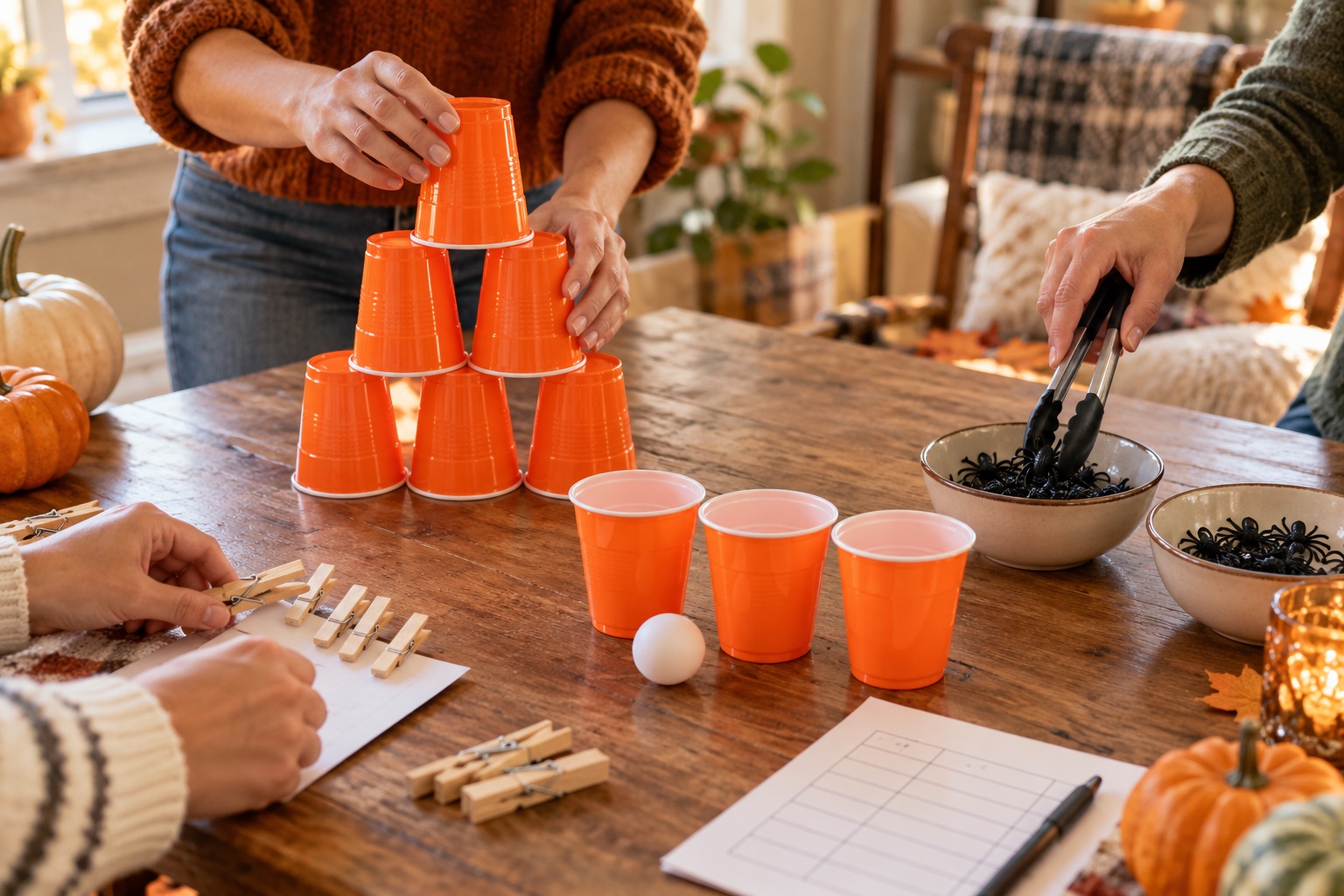
For: Teens ages 13+ and adult friends
Activity steps
Set up matching game lanes
This version is for teens and adult friends, ages 13+. Make one lane for each group of up to six guests: one lane for 2–6, two for 7–12, three for 13–18 and four for 19–24. Divide guests as evenly as possible. Give each lane a firm, smooth table area, ten matching stackable 12–16 oz plastic cups, six 40 mm table-tennis balls, twelve same-size small plastic spiders, one pair of short tongs, two small bowls, ten clothespins, one sturdy plastic plate and one tray. Use orange cups if available; plain cups work with a pumpkin sign. Put unused pieces on the tray between rounds. Keep the game pieces and game-use dishes away from the drink station.
Make the scorecards and demonstrate
Use six blank cards per lane: four with the challenge names and scoring below, one with a grid for up to six player names and four scores, and one lane sign with a pumpkin, ghost, spider or bat drawing. Share a marker set per lane. Set one phone to sixty seconds. The current judge in lane 1 starts the shared timer and calls start and stop with a raised hand; other lane judges repeat the signals. Put the phone where the timekeeper can see it and call the last ten seconds aloud. Demonstrate each challenge, then allow each guest a ten-second practice before their scored attempt. Use an existing ruler or tape measure to make all bounce release lines 30 cm from the nearest target cup and to space the spider bowls 30 cm apart. Patch-test removable painter’s tape before marking the table, and follow its removal instructions.
Give everyone all four turns
All lanes play the same challenge together. Number players within each lane. On the first signal player 1 plays, player 2 judges, and any other players watch or reset supplies. On the next signal player 2 plays and player 3 judges; the last player is judged by player 1. With two guests, swap player and judge. Allow sixty seconds of play and at least thirty seconds to record the score and reset after every turn. Finish every player’s turn before switching challenge. A smaller lane pauses while longer lanes finish. Each guest gets one scored attempt at every challenge, with no elimination. Allow about 25 minutes for two guests and up to 50 minutes for groups whose largest lane has six.
Round 1: Pumpkin Pyramid
Start with all ten cups nested in one stack. At go, use one hand to turn each cup upside down and build a pyramid with four cups on the bottom, then three, two and one, take both hands clear for two seconds, then return all ten cups to one nested stack. The other hand stays off the cups and table. Rebuild fallen cups while time remains. The judge records the highest milestone completed before sixty seconds: 1 point for the bottom two rows of seven cups standing hands-free for two seconds, 2 for the complete ten-cup pyramid standing for two seconds, or 3 for the complete pyramid followed by all ten cups nested again. Do not add the milestones together.
Round 2: Ghost Bounce
Use three of the cups as empty targets, close together in a triangle. Place six white balls behind the release line, 30 cm from the nearest cup. Release one ball at a time with your hand behind the line, bouncing it on the table between the line and cups toward an empty cup. A release over the line does not score; each ball must bounce at least once before landing. Leave successful balls in place. The judge may return misses that stay on the table, but nobody chases a floor ball while play continues. Stop when all three cups contain a ball or sixty seconds ends. Score 1 point per cup containing at least one ball, up to 3; extra balls in the same cup earn nothing. Return all six balls before the next turn. No drinks go in the game cups.
Round 3: Spider Rescue
Put twelve matching small spiders in one bowl and leave the other empty, with a 30 cm gap between their rims. Use the same spider size in every lane. With one hand holding the tongs, move one spider at a time to the empty bowl. The other hand may steady the source bowl but cannot touch a spider. A dropped spider stays where it falls until the round ends. Count spiders completely inside the destination at sixty seconds: 3–5 earns 1 point, 6–9 earns 2, and 10–12 earns 3. Fewer than three earns 0. Return all twelve to the start bowl before the next turn. Keep these small decorative parts out of mouths and away from younger children and pets.
Round 4: Bat Clip Sprint
Put ten clothespins on the tray and the plate on the table. Hold or steady the plate with one hand. With the other, clip all ten pins separately around the rim, then remove them one at a time back onto the tray. Do not slide pins on without opening them. The judge records the highest milestone reached before sixty seconds: 1 point for at least five pins attached at the same time, 2 for all ten attached, or 3 for all ten attached and then returned to the tray. No points are added together. Keep pins away from skin, hair and clothing; discard any cracked or splintered pin.
Choose access options before the clock starts
All rounds can be seated at a comfortable table height. Use a clear spoken start plus a raised hand, and keep the countdown visible. Agree changes before practice: use both hands for stacking, move targets closer, let a partner steady the plate, or transfer spiders by hand instead of tongs. For a bounce alternative, lay the three cups on their sides with their openings facing the player and roll the balls into them from the same line. Stabilize each cup with a small tape loop after patch-testing. Score a cup only when a ball remains inside at the stop. Guests may keep a personal score with their agreed rules, share actions with a helper, or take a judging role without competing. A shared-action turn still uses that guest’s place in the turn order and is recorded under their name as a cooperative score, outside solo ranking. Rank only solo guests using the same version; celebrate personal bests in adapted rounds.
Add the scores and pack away
Record zero when no scoring milestone is reached. Add the four scores for a total out of twelve. Highest total wins, and tied players share the win. No purchase or prize is required. Keep the cards as a record, remove tape as directed, and count every ball, spider and pin back into its original packaging before opening the table to other activities. Keep any kitchen equipment used for games separate from food service for the rest of the party.
Host tip: The guide uses table skills, not dancing, eating contests or running. Ask about access needs before assigning lanes. The selected spider decorations are labeled for ages 12+, so this supply list is not a younger-child version. The budget assumes borrowed cups, dishes, trays, tongs, markers and a phone; buying every suggestion will cost more.
For teens ages 13+ and adults. The selected small spider decorations are labeled ages 12+; this is not a younger-child activity. Keep small pieces away from younger children and pets. All four rounds support seated play, agreed adaptations or a judging role. Use a clear, stable table with space between lanes; no running or food games.
Shopping list for 6 people
- Matching stackable game cups: 10 cups
- White table-tennis balls: 6 balls
- Small Halloween game spiders: 12 small spiders
- Short tongs for Spider Rescue: 1 pair of tongs
- Wooden game clothespins: 10 clothespins
- Reusable plates: 1 plate
- Small bowls for cookie toppings: 2 bowls
- Reusable serving trays: 1 tray
- Recipe, tasting and game cards: 6 cards
- Washable marker assortment: 1 set
- Removable tape for game lines: 1 roll
- A ruler or tape measure from home: 1 measure
Use supplies you already have. Enable JavaScript to adjust guests and mark what you need.